
Google Adds Flex and Priority Tiers to the Gemini API
TOOLS
This one is less flashy than a new model launch. But honestly? It might matter more for how AI products actually get built.
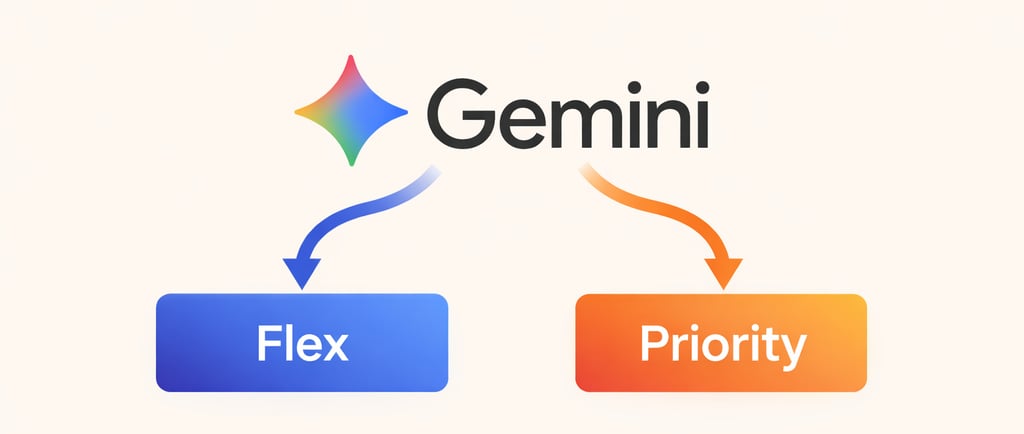
On April 2, Google introduced two new service tiers to the Gemini API: Flex and Priority. And while that sounds like a pricing update, what's really happening here is a real step forward. Google is finally giving developers the infrastructure tools they need to build serious production applications.
Let's break it down.
What Flex actually is
The core problem Flex and Priority solve is pretty specific: as AI moves from simple chat into complex autonomous agents, developers typically have to manage two distinct types of logic: background tasks that don't need instant responses, and interactive tasks where high reliability is critical [Google]. Until now, supporting both in the same product meant splitting your architecture between two entirely different systems.
Flex is the solution for the background side. It costs 50% less than the standard rate by routing requests through off-peak compute capacity. Latency can range from 1 to 15 minutes and isn't guaranteed [CoinCentral]. Think: CRM updates, data enrichment, offline evaluations, longer research workflows. Stuff that doesn't need to happen in the next second.
What makes Flex useful beyond just being cheap is how it works technically. Unlike the existing Batch API, Flex uses synchronous endpoint architecture, so developers avoid the overhead of managing file inputs and outputs or monitoring job completion status [Parameter]. Same cost savings, without the engineering headache.
And then there's Priority
The Priority tier is designed for business-critical workloads that require lower latency and the highest reliability [Google AI]. We're talking customer service bots, fraud detection, live content moderation. Anything where a slow or dropped response is actually a problem. It costs 75% to 100% more than standard rates, and if a user's Priority traffic exceeds set limits, overflow requests automatically drop to Standard tier rather than failing outright [CoinCentral]. That graceful degradation is a thoughtful detail. Instead of getting a 503 error at the worst possible moment, you just get a slightly slower response.
Priority is restricted to Tier 2 and Tier 3 billing accounts, which require cumulative Google Cloud spending thresholds of $100 and $1,000 respectively [Threads].
Why this is actually a big deal
The real story here is what these tiers signal about the state of AI tooling.
Until recently, most AI APIs were pretty binary. You sent a request, you got a response, and the only real variables were which model you used and how many tokens you burned. That was fine for demos and prototypes. It's not fine for production applications that need to serve thousands of users with different needs at the same time.
Flex and Priority help bridge the gap between background tasks and interactive tasks, both through standard synchronous endpoints. This removes the async job management overhead while giving developers the economic and performance benefits of specialized tiers [Google].
What Google has done here is bring quality-of-service tiers into the AI API layer. Cloud infrastructure has had this kind of control for years. It's a maturity milestone for AI tooling, and it means developers can now design products that behave differently for different situations without stitching together completely separate architectures.
The switching cost is minimal too. Both Flex and Priority tiers use the same service_tier parameter in API requests. Developers can toggle between tiers with a single config change [CoinCentral]. That kind of low-friction design is exactly what production teams need.
What to watch next
Google isn't the only one thinking about this. As AI agents become more common, the question of how to route different types of work to the right infrastructure at the right cost is going to matter a lot more.
Expect OpenAI and Anthropic to build similar infrastructure controls into their APIs over the next year. The developers building the most serious AI-powered products aren't just picking the best model anymore. They're thinking hard about reliability, cost efficiency, and what happens when things go wrong at scale.
Flex and Priority are Google's answer to that problem. And they're a good one. This might not be the most exciting AI story of the week, but it's the kind of update that quietly makes building real products a lot easier. That matters more than another benchmark win.